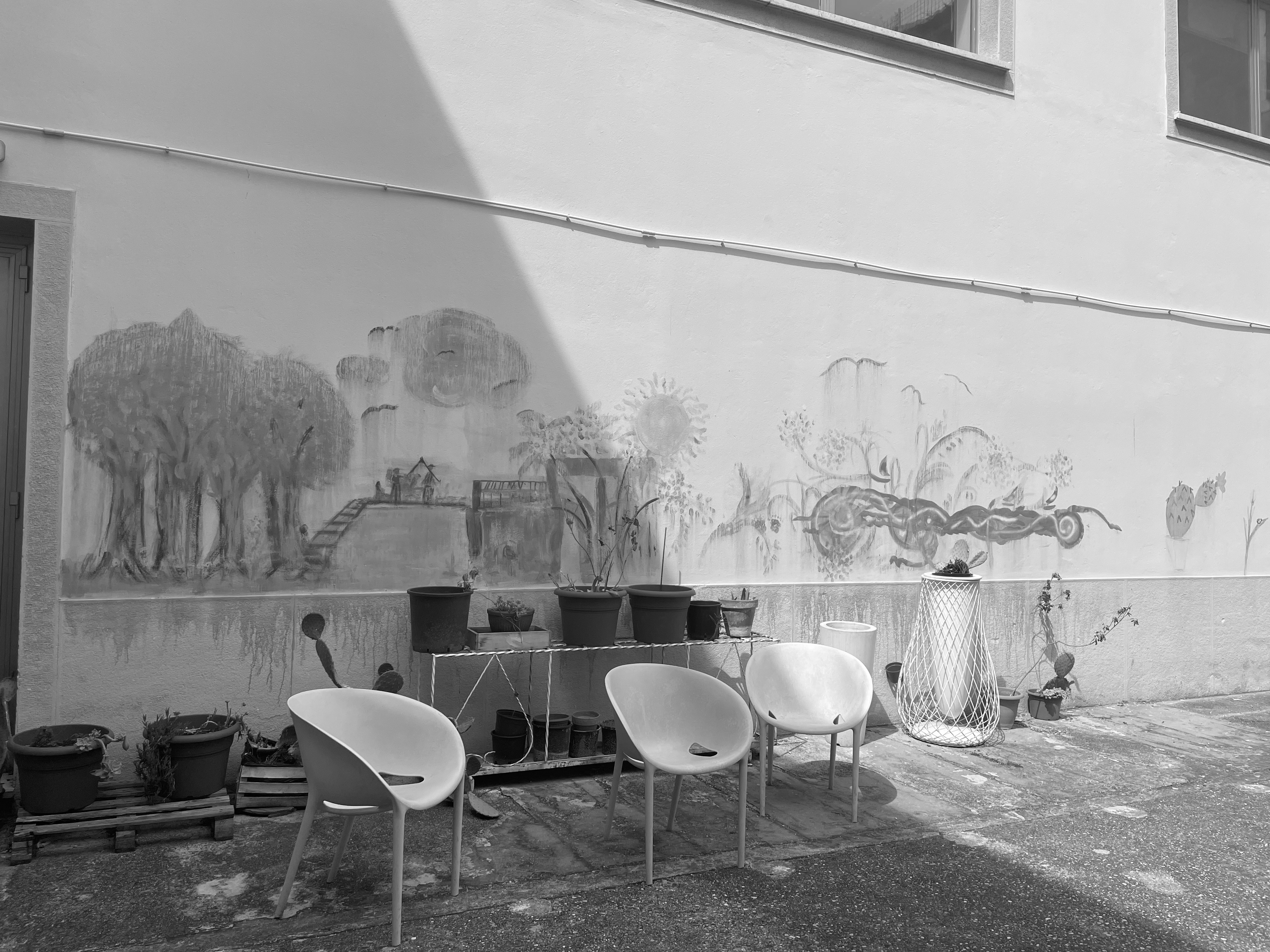
Ambulantisierung der Psychiatrie – Erfahrungen aus Triest als mögliche Auflösung eines Laing’schen Knotens der Bettenbehandlung

[Anm. d. Red.: Dieser Artikel ist nicht identisch mit dem Original, das in den Sozialpsychiatrischen Informationen veröffentlicht wurde. Die veröffentlichte Version von Milan Röhricht, Ambulantisierung der Psychiatrie – Erfahrungen aus Triest als mögliche Auflösung eines Laing’schen Knotens der Bettenbehandlung, Sozialpsychiatrische Informationen 3/2025, ist online unter (URL) zu finden.]

You don’t flee through an open door

because the door is open

because the door is not closed

you flee through a closed door.

But you could flee through an open door

because the door is open

therefore you should close the door

because you could flee through an open door.

So you could flee through an open door

but also through a closed door

therefore you could open the door

            or you should not close the door

therefore you could close the door

            or you should not open the door.

Die geschlossene Tür steht hier im weiteren Sinne für die Bettenbehandlung psychisch kranker Menschen. Dieser Text ist im Stil von R.D. Laings Gedichtband Knots (1970) entstanden, in dem er die zirkulären Verstrickungen menschlicher Bindung sprachlich erlebbar macht. Ein solcher Laing’scher Knoten ließe sich übertragen auf die Zirkularität stationären Entkontextualisierung (Heißler 2022, 80), der erlernten Hilflosigkeit, der zunehmenden Gewalt usw. usf. Um den Knoten zu lösen, hilft zunächst der Blick auf einen Gegenentwurf zur Bettenbehandlung: das Triester Modell.

Continue reading “Ambulantisierung der Psychiatrie – Erfahrungen aus Triest als mögliche Auflösung eines Laing’schen Knotens der Bettenbehandlung”

Das Triester Modell

[Anm. d. Red.: Dieser Artikel erschien im Oktober 2024 bei Gesundheit braucht Politik, Ausgabe 3/24: https://www.vdaeae.de/gesundheit-braucht-politik/archiv/gbp-ausgabe-3-2024/]

Auch im Bereich der Psychiatrie werden in Deutschland Möglichkeiten zur besseren ambulanten Versorgung diskutiert.[1] Neben den Fragen der Ressourcenverteilung und Kostendeckelung im Rahmen eines marktwirtschaftlich organisierten Systems beinhaltet die Auseinandersetzung mit der Ambulantisierung in der Psychiatrie dabei mindestens zwei Besonderheiten: Zum einen wird um die Deutungshoheit bezüglich des grundsätzlichen Verständnisses von psychischen Krankheiten gerungen; dabei spielt die Frage, was ein Versorgungssystem, dessen Aufgabe zumindest in Teilen streitbar bleibt, überhaupt leisten soll, eine entscheidende Rolle. Zum anderen wird die Doppelfunktion, welche die Psychiatrie nach wie vor übernimmt – nämlich neben der Krankenversorgung auch die gesellschaftliche Ordnungsfunktion der Gefahrenabwehr und Ausübung sozialer Kontrolle – intensiv debattiert.

Continue reading “Das Triester Modell”

Die Patientin, die Touristin und die rhizomatische Ebene

[Anm. d. Red.: Dieser Artikel ist nicht identisch mit dem Original, das in den Sozialpsychiatrischen Informationen veröffentlicht wurde bzw. zur Veröffentlichung vorgesehen ist. Die veröffentlichte Version von Milan Röhricht, Die Patientin, die Touristin und die rhizomatische Ebene, Sozialpsychiatrische Informationen 4/2021, ist online unter (bitte URL angeben) zu finden.]

Die 20-jährige Anne Rau, die nach einem Selbstmordversuch in eine psychiatrische Klinik aufgenommen wurde, fand schließlich den richtigen Ausdruck, um zu vermitteln, was ihr fehlte: etwas kleines und einfaches, aber unermesslich Wichtiges. Sie nannte es eine natürliche Selbstverständlichkeit. Sie fühlte sich unfähig, mit anderen Kontakt aufzunehmen, wie eine Außerirdische im Raum zog sie immer unerwünschte Aufmerksamkeit und verwunderte Blicke auf sich. Dabei war es, als stelle sie einen Widerspruch zu ihrer Umgebung dar und dies evozierte bei ihr ein Gefühl der Einsamkeit und Distanziertheit. Es war die grundlegende Menschlichkeit, die sich als schwierig erwies: sie konnte sich nicht in andere einfühlen und verweilte unentschlossen auf Fragen des Handelns und des Lebens. Schließlich wurde sie von ihren Zweifeln verzehrt und beschloss, nach reiflicher Überlegung, ihr Leben mit Schlaftabletten zu beenden. Es blieb ein ernsthafter, aber vergeblicher Versuch, und sie wurde folglich in die psychiatrische Abteilung der Freiburger Universitätsklinik eingeliefert, wo eine Schizophrenia simplex diagnostiziert wurde, ein Subtyp der Schizophrenie, der durch chronisch negative Symptome wie Apathie und Antriebsminderung gekennzeichnet ist und oft nicht mit psychotischen Positivsymptomen wie Wahnvorstellungen oder Halluzinationen einhergeht. Über einen Zeitraum von vier Jahren wurde sie mittels Psychotherapie, Psychopharmaka und Elektrokrampftherapie behandelt. Trotz Schwankungen in ihrer Suizidalität blieben ihre Symptome – ihr zugrundeliegender „Verlust“ natürlicher Selbstverständlichkeit – weitgehend unverändert, und sie beendete ihr Leben vier Jahre nach dem ersten Krankenhausaufenthalt.

Continue reading “Die Patientin, die Touristin und die rhizomatische Ebene”

The patient, the tourist and the rhizomatic plane

[Editors’s note: this article is not identicle to the German translation (to be) published in the Sozialpsychiatrische Informationen. The published version by Milan Röhricht, Die Patientin, die Touristin und die rhizomatische Ebene, Sozialpsychiatrische Informationen 4/2021, is available from October 2021]

Anne Rau, a 20-year-old admitted to a psychiatric ward after attempting suicide, eventually found the right phrase to convey what she was missing: something small and simple yet immeasurably important. She called it natural self-evidence. She felt unable to connect with others around her, like an alien in the room, always attracting unwanted attention and looks of bewilderment. She felt distanced, lonely, and at odds with her surroundings. It was the basics of humanity which proved most difficult: she couldn’t empathise with others, and she dwelled on questions of how to mature, how to act and how to live. Eventually she was consumed by doubt. After some deliberation she decided to end her life with sleeping pills. It remained a serious yet futile attempt, however, and she was consequently admitted to Freiburg University Hospital’s psychiatric unit, where she was diagnosed with schizophrenia simplex. This subtype of schizophrenia is characterised by chronic negative symptoms[1] such as apathy and lack of energy, often without psychotic positive symptoms such as delusions or hallucinations. Over a period of four years she received psychotherapeutic and pharmacological therapy as well as electroconvulsive shocks. Despite fluctuations in her suicidality, her symptoms — her underlying ‘loss’ of natural self-evidence — remained largely unchanged, and she ended her life four years after her initial hospitalisation.

Continue reading “The patient, the tourist and the rhizomatic plane”

Observations from an open circle

[Editor’s note: the following observations were made by the author over a period of four months during a fortnightly philosophical reading group with patients in a psychiatric rehabilitation institution. Friedrich Nietzsche’s ‘On the Genealogy of Morality’ was read. To ensure anonymity certain facts have been altered, leaving a representative, but in no way replicable account. An abridged version of this essay was published on Mad in America – https://www.madinamerica.com/2020/02/observations-open-circle/]

*

Dear patients,

I would like to warmly invite you to take part in a philosophical reading group. In an open circle we will discuss and explore basic questions of meaning and being, and the world in which we find ourselves, on the basis of articles, book excerpts, personal opinions…

Participants: to enable a lively debate, the number of participants is limited to 8 people

When: Wednesdays, every 14 days, 18:00 — 19:30

No prior knowledge required!

Continue reading “Observations from an open circle”

Institutional Psychotherapy

[Editor’s note: this is an addendum to the article ‘Demystifying phenomenological and social psychiatry’ (Isolatarium, 1/2019). Although it is published separately here, it has also been integrated into the aforementioned article.]

Commonly considered as conceptional founders of Institutional Psychotherapy (IP) [1] are François Tosquelles, Jean Oury, Hermann Simon, Frantz Fanon and George Canguilhem. Their work built upon the theory of Jacques Lacan, which was later complemented by Félix Guattari and Gilles Deleuze. Many of these individuals were heavily influenced by the experience of occupation during World War Two; of totalitarian oppression on either side of France. Such personal experiences of incarceration engendered the rethinking of institutional confinement within the psychiatric field, which became a central element to IP. Likewise these individuals had a shared conviction that social and psychological problems should be simultaneously broached, and not studied or treated independently. Within the institution this was addressed through a horizontal, radically democratic therapeutic approach. Two important examples are Saint-Alban in southern France, where IP was initially conceptualised, and La Borde Clinic south of Paris — founded by Jean Oury in 1951 and still open today.

Continue reading “Institutional Psychotherapy”

Demystifying phenomenological and social psychiatry

Contents

Introduction

Theoretical aspects (Philosophical considerations: phenomenology and anthropology; Anti-Psychiatry; Neuropsychiatry; Terminology: ‘social psychiatry’ vs. ‘socialpsychiatry’; Embodied and enactive cognition)

Institutional and methodological aspects (Milieu therapy; Therapeutic community; Soteria; Institutional Psychotherapy; Open dialogue; Trialogue, incl. psychosis seminars)

Conclusion

Recommended literature

Continue reading “Demystifying phenomenological and social psychiatry”

Envisioning a future for psychiatric care

[Editor’s note: many of the concepts only touched upon here are clarified in the accompanying article ‘Demystifying phenomenological and social psychiatry’.]

T. F. Main coined the term therapeutic community (TC) [1] as both a manner and method of psychiatric care shortly after World War Two, highlighting institutional deficits of conventional hospitals which may thus be addressed: “The concept of a hospital [means] that patients are robbed of their status as responsible human beings […] making them ‘patients’ […] in a state of retirement from society.” [2] However, it was only under Maxwell Jones’ influence in the 1950s that the TC concept gained support, becoming a replicable method with certain characteristics [3] — small size of no more than 100 persons, daily community meetings, [4] and the psychodynamic hypothesis as an underlying philosophy.

Continue reading “Envisioning a future for psychiatric care”

Impressions from a closed psychiatric ward

[Editor’s note: to ensure anonymity of the patient data as well as the institution, all of the facts and quotes included have been altered, leaving a representative, but in no way replicable account. Further, the author has asked to remain anonymous.]


“When suffering from a mental illness one no longer has a free will.”

A floor plan of the ward should have been included here, illustrating the conditions in which patients are being forced to ‘live’. However, to ensure I am not legally compromised (trade and corporate secrets etc.), I have been advised against including this. In the hope of enabling some insight here is a brief description:

The ward’s capacity is 30 patients, though this is frequently surpassed. Patient rooms range from approx. 8㎡ to 20㎡, most of them double rooms, each with a toilet and shower. Some rooms can be locked from the inside, most cannot. The total garden space is less than 500㎡, divided into smaller segments, one length no longer than 25m. The total community space is approx. 60㎡, in which patients eat, relax, socialise and watch TV.

Continue reading “Impressions from a closed psychiatric ward”

Effect of cannabis potency on the consumer

Cannabis is the most widely used illegal drug in the world, with the predicted number of users exceeding 200 million people (UNODC, 2015). Within Europe, it is estimated that a quarter of the population aged between 15-64 years have tried cannabis, with nearly 7% indicating they have consumed it in the past year (EMCDDA, 2016). This frequency of use far surpasses the use of other illegal drugs: cocaine, the second most frequently used drug, is reported to have a lifetime use of 5.1%, with only 1.1% claiming to have consumed the drug in the past twelve months (EMCDDA, 2016).

Continue reading “Effect of cannabis potency on the consumer”